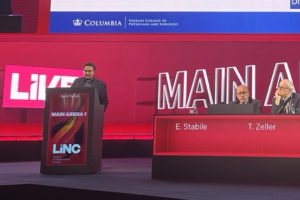
In a session at the 2026 Leipzig Interventional Course (LINC; 27–31 January, Leipzig, Germany) dedicated to pulmonary embolism (PE) management, Sahil Parikh (Columbia University Irving Medical Center, New York, USA) extolled the benefits of a PE response team (PERT). Parikh showcased the PERT framework in place at Columbia—highlighting positive effects on length of hospital stay—while stressing there is no one-size-fits-all blueprint for success.
Parikh’s interest in the PERT model was first piqued 20 years ago during his training at Massachusetts General Hospital. He described to the LINC audience a disjointed approach to the management of PE at the Boston, USA-based institution during his time there as a fellow, with patients’ treatment varying based on their first point of contact with the hospital.
This all changed with Kenneth Rosenfield, who Parikh dubbed “the godfather of the PERT”, initiated the adoption of a unified approach to managing PE patients at Mass General along the lines of the ST-elevation myocardial infarction (STEMI) team there.
It was this move that laid the groundwork for the current PERT model at Columbia. “We have created a similar team that is really chartered to promote multidisciplinary models of care, expand the scientific body of literature, and educate the general public,” Parikh noted.
The presenter cited key learnings from Rosenfield, including that the PERT has core members based in three disciplines: interventional cardiology, pulmonary and critical care medicine (including pulmonary hypertension), and cardiothoracic surgery—with ad hoc membership of other specialties such as haemotology, interventional radiology (IR), and vascular surgery.
Parikh continued that members of the PERT at Columbia are activated through a single pager, with all members of the team then deciding collectively on the best care plan for each individual patient.
Columbia is a member of The PERT Consortium—the main organisation dedicated to advancing PERTs across the USA—which Parikh notes provides a number of algorithmic approaches to managing high-risk, intermediate-high-risk, and low-risk PE interventions. In addition, he pointed to its offering of algorithmic care for follow-up, noting that the Columbia team follows this “fastidiously”.
While stressing that every PERT must possess a core clinical skillset, Parikh also noted that there are no cast-iron rules for the specialty makeup of each group. “Every centre looks different,” he said, referencing Rosenfield’s mantra that “if you’ve seen one PERT team, you’ve seen one PERT team”.
“Every hospital has a coalition of the willing that participates in the care of these patients,” Parikh continued.
Risk and reward
This involvement of several groups, however, comes with certain challenges. “One of the things that frequently comes up, at least in the American context—and I would dare say probably in other parts of the world—is how do you deal with competition between specialties?” the presenter put forward. “There’s a lot of competition to take care of these patients.”
The solution, according to Parikh, is ensuring everyone has a seat at the table. “Since there are so many different groups involved in the care of these patients, we try to make it as big of a coalition as we can,” he said. “We try to get as many people involved as possible and make it a win for everybody.”
Parikh notes that this approach addresses the crux of the issue regarding interspecialty competition: accessing revenue. “We avoid competition by sharing the risk and the reward,” he said. “And while that’s difficult with current silos of care, we have both tacit and explicit understanding between disciplines.”
By way of example, Parikh highlighted rotational schedules implemented at some institutions regarding which specialties will do the procedures and which specialties will manage the patients, taking a competency-based approach to steer clear of competition. “All invasive procedures must be performed by people who understand and can perform a right-heart catheterisation and can understand right ventricular haemodynamics, since patients mostly are in obstructive shock and/or in normotensive shock when you take them to the cath lab or the endosuite for these interventions.”
Parikh also lauded the benefits of participating in clinical trials to “grow the pie” for all specialties involved. He noted the Columbia team’s involvement in the PE Tract National Institutes of Health (NIH)-sponsored randomised controlled trial (RCT) and the STRIKE-PE registry, for example, among several others.
The success of this collaborative approach, Parikh continued, is evident in the numbers, with the presenter noting that PERTs are becoming increasingly common. “There’s probably close to 300 in the USA alone, and I’m sure many hundred outside the USA,” he stated.
Finally, Parikh highlighted the data showing PERTs’ association with improved outcomes for patients. The Columbia PERT has reduced length of hospital stay of high-risk pulmonary embolism by over 40% in their health system, Parikh shared with the LINC audience.
Imparting further supporting evidence, Parikh referenced the COVID-19 pandemic. “The biggest advertisement for us was the COVID pandemic,” he said. “Our PERT activations doubled over a historical time period. And ever since, we’ve stayed very, very busy because our role in the care of these patients has become established in our centre.”
Concluding, Parikh stressed that “there’s no magic formula” for the ideal PERT setup. “All I can [say] is that you need to have a PERT if you want to [treat PE patients] effectively,” he said. “Collaboration in the space has been demonstrated to improve care, the data on fiscal viability is now emerging, and it’s also viable for all participants.”
“An integrated approach for pre-, periprocedural, and post-procedural care is really important, and there are system-wide benefits that are greater than the procedural revenue.”