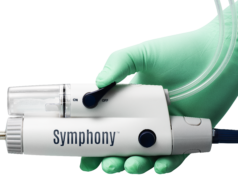
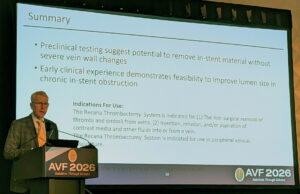
Early clinical experience with the Recana thrombectomy catheter system (InterVene) for the treatment of venous in-stent restenosis (ISR) suggests its feasability to improve lumen size in chronic in-stent obstruction, the 2026 American Venous Forum annual meeting heard (28 February–4 March, Denver, USA).
William Marston (Chapel Hill, USA) presented data on preclinical testing of the device in 13 pigs, as well as insight from the three clinical cases he has performed so far. Drawing on a sample case involving a 46-year-old male who had stenting performed in 2023, Marston told those gathered how after a few years the individual developed a restenosis and, eventually, occlusion of the stent. After Marston and colleagues performed a balloon angioplasty to expand the lumen, the patient received a Recana intervention, which resulted in the successful clearance of “organized ISR material to restore patency”, “improved cephalad flow and increased luminal area”, he told AVF 2026.
Around 24 cases involving the Recana catheter—cleared by the US Food and Drug Administration (FDA) in December—had been performed worldwide as of Marston’s appearance at the AVF 2026 podium, most of them led by Stephen Black (London, UK). “The device does show the potential to remove in-stent material without severely [causing damage] along the vein wall,” Marston said. “Early clinical experience demonstrates feasibility. Obviously, follow-up [is going to show] if these veins stay open.”