Veinsound recently announced the successful launch of its first-in-human (FIH) EASY-VEIN NT trial, which has been designed to assess artificial intelligence-focused ultrasound (AIFU) for the treatment of chronic venous insufficiency (CVI) and varicose veins.
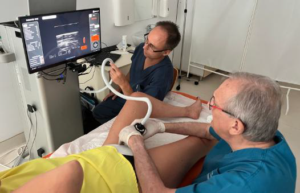
The first patients were treated at Sanconfind Medical Center in Câmpina, Romania, with Veinsound reporting positive early clinical observations.
“Treating the first patients marks a significant milestone in our development. This helps assess whether AIFU can treat CVI and the great saphenous vein [GSV], in an office setting, without heat, needles or catheters. The value proposition we have championed from the start—a simple, fast, anaesthesia-free and in-office treatment—is now becoming a clinical reality. I warmly thank the patients and the investigators who make this study possible,” says Thomas Charrel, CEO of Veinsound.
To date, principal investigator Zoltan Galajda (Sanconfind Medical Center, Câmpina, Romania) has treated four patients using the AIFU system. “As a clinician, I’m always looking for innovations that improve patient outcomes while simplifying procedures. The AIFU device delivers on both fronts. Precision and simplicity observed in the first treated patients are impressive and highly encouraging. I’m confident this technology will set a new standard in venous care,” he remarks.
Following completion of the safety cohort, the first patients in the performance group have been treated along their GSV in less than 12 minutes without anaesthesia. “The first patients treated with AIFU technology showed promising results, with smooth and complication-free procedures. Preliminary observations at one week post-treatment—including vein occlusion and vein-wall remodeling—are very encouraging. If these preliminary results are confirmed in this study, AIFU will be a game-changer for physicians and patients who want effective treatment without injection, surgery or downtime,” adds co-investigator René Milleret (Sanconfind Medical Center, Câmpina, Romania).