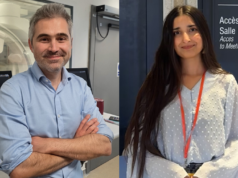
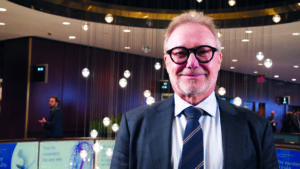
Following a successful financing round in late 2025 to the tune of 24 million Swedish Krona, MedVasc finds itself in a position to target US Food and Drug Administration (FDA) clearance for the Solutio catheter. This technology is designed to make intravenous anaesthesia delivery during endothermal ablation for varicose veins less painful and has shown promise in early studies. At this pivotal point for the Malmö, Sweden-based venture, Venous News caught up with founder and interventional radiologist Michael Åkesson (Scandinavian Venous Centre, Malmö, Sweden) to discuss the origins of the technology, the winding road to regulatory approval, and the team involved.
When did MedVasc start and how did the idea for the company originate?
MedVasc was started in 2013 and came from an idea that I had when I was working with patients in our Scandinavian Venous Centre facilities in Malmö. I saw that a number of patients experienced high levels of pain and discomfort during tumescent anaesthesia deployment for endothermal varicose vein ablation and thought that maybe we could perform this part of the procedure in a better way, using new techniques. At the time, glue wasn’t quite there yet, but I started to question, could we administer the tumescent solution in a way that it would be less painful?
I came up with the idea that we could introduce tumescent anaesthesia from inside the vein instead. Because there are no pain receptors inside the vessel wall, this option could be pain free. I found this out when I was working at the University Hospital SUS here in Malmö doing a lot of subintimal recanalisation. Even when we perforated the arteries, the patients didn’t feel anything. That gave me the idea that we could go inside the veins as well. That was the basic idea—to help patients be more comfortable.
I contacted various colleagues I had worked with previously on other devices to brainstorm and get the idea off the ground, and the company started from there.
How did things progress?
The problem was always raising funds, which takes up around 70% of your time when you are developing a technology such as this. But by 2019, we had reached a stage where we were ready to test the technology in humans based on positive results from our animal studies. We ran a small safety and feasibility study at the Scandinavian Venous Centre and were pleased with the results. The patients didn’t feel much pain at all when we put the tumescent anaesthesia in place.
However, we saw that there were some issues that we had to solve, like having a catheter that could fit all types of endothermal techniques. We were also hit by the COVID-19 pandemic and everything stopped for three years. We couldn’t raise any money, and we couldn’t make any progress.
Eventually, the funding started to come in again, and I employed my CEO [chief executive officer], Cathrin Johansson. She was instrumental in helping us source further funding and with that we have been able to develop the product. The technique is the same, but we now have a second prototype that is a little different from the first iteration.
We have now raised enough money to perform another human study and further animal studies, which we are hoping will take us all the way to the market in the USA. We’re planning to go for FDA clearance during Q4 this year. That’s where we are right now.
What does the US FDA approval process look like?
We have had several pre-submission meetings discussing the regulatory pathway for our 510(k) submission which includes various bench tests, pre-clinical and clinical data. Initial data from the animal study look promising and the plan is to kick off our clinical study including 30 patients mid-April.
When we have the results from both, together with the technical file, we should have everything we need to send to the FDA for their review, which we are hoping to do during the summer.
How does this compare to the process in Europe now?
Historically, CE marking was faster and easier than FDA approval, but the shift in 2021 to MDR [Medical Device Regulation] changed that. Things are looking much better on the European side now. In theory, our case could be looked at in maybe six months compared to the three or four years it used to be.
Also, for the human study that we are doing now, we have to provide all the same details that are required for MDR. Therefore, when we have completed that study, we should have all the necessary information we need to go for MDR as well.
Could you speak a bit about the team involved in the clinical studies you’re conducting at the moment?
At the Scandinavian Venous Centre in Malmö, we have a mix of interventional radiologists, vascular surgeons, and general surgeons treating varicose vein patients. I’m an interventional radiologist, but my colleague here who was the PI [principal investigator] for the first study is a vascular surgeon. He’s almost retired now, but the new PI is also a vascular surgeon who’s working at our facilities in Gothenburg, Sweden. She is planning to come down here to Malmö. So, we have a really multidisciplinary group working on this project.
What’s the overarching goal with this technology?
I would say that our goal is to make treatment for varicose veins as simple and easy as possible for both patients and physicians. Hopefully we can achieve this very soon once the technology is on the market. I think it will help a lot of patients and physicians. For the patients, tumescent is the most uncomfortable part of varicose vein surgery and, for physicians, it’s the most difficult part of the procedure. With our technology, I think we can provide a faster and better way to perform the endothermal technique. Hopefully, this will be a gamechanger.