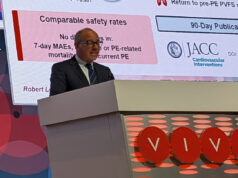
 “Are we at the end of the road with this technology?” asked attendees of yesterday’s opening venous and lymphatic session at the 2026 Charing Cross (CX) Symposium (21–23 April, London, UK), which spotlighted recent heavy-hitting trials in support of intervention for pulmonary embolism (PE).
Investigators from STORM-PE, STRIKE-PE and HI-PEITHO, among other experts, discussed PE risk stratification and how to build the optimal team, as well as accurate measures to understand mid- to long-term functional outcomes and the development of chronic thromboembolic pulmonary hypertension (CTEPH).
Questions from the floor turned to long-term follow-up in the HI-PEITHO cohort and how important this may be in patients who benefit from anticoagulation. Principal investigator (PI) Stavros Konstantinides (Mainz, Germany) responded that, although CTEPH is rare, patients often experience severe symptoms. “We hope that early thrombus reduction improves these outcomes, but we will have clearer answers within the next year”, he said.
Given the positive result for intervention in each of the aforementioned trials, discussion turned to where PE technology can go next. From the audience, David Dexter (Norfolk, USA) asked: “Is this as good as it gets? Are we looking at large-bore catheters or adjuncts to treat more distal thrombus?” A query to which STRIKE-PE global PI John Moriarty (Los Angeles, USA) responded that, unlike Francis Fukuyama who declared the ‘end of history’, technology in this space will continue to innovate.
“Having seen the new guidelines, having heard about haemodynamic and longitudinal evaluation, having the ability to continually monitor, to be more specific about how we take the clot out of large versus small, central versus peripheral—there are going to be many iterations that come through these devices,” Moriarty described.