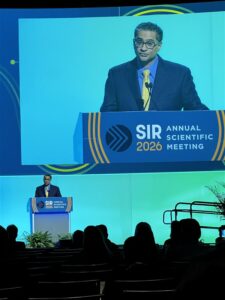
“These patients have suffered in silence because few physicians are aware of this complication or know how to effectively treat it,” said Suresh Vedantham (WashU Medicine Mallinckrodt Institute of Radiology in St Louis, USA), principal investigator of C-TRACT, presenting results of the National Institutes of Health (NIH)-sponsored trial at the Society of Interventional Radiology (SIR) annual scientific meeting (11–15 April, Toronto, USA). Findings were simultaneously published in the New England Journal of Medicine.
Vedantham reported significantly greater improvement in post-thrombotic syndrome (PTS) severity following deep vein thrombosis (DVT) when treated with endovascular therapy (iliac-vein stent placement and enhanced antithrombotic therapy) plus standard PTS care compared with standard PTS care alone.
C-TRACT enrolled 225 patients with moderate to severe PTS at 29 institutions and was led by researchers from multiple specialties, including interventional radiology (IR). Patients were randomly assigned to one of two treatment groups—the active treatment group which received blood-thinning drugs, compression treatment (such as stockings), along with placement of stents in blocked veins that drain blood from the leg by physicians who were mostly interventional radiologists, and a control group that received blood-thinning drugs and compression treatment without stenting.
The trial found that patients in the stent treatment arm showed significantly greater improvement in their PTS severity than the control arm patients, and that this resulted in noted improvement in their self-reported quality of life through six months. Initially, 93% patients were classified as having “severe”, assessed using Venous Clinical Severity Score (VCSS) at six months, whereas only 40% of patients in the stent treatment arm had severe disease. Through six months, bleeding was more common in the endovascular-therapy group than in the no-endovascular-therapy group.
During a roundtable hosted at SIR 2026, Vedantham spoke to the significance of the C-TRACT results: “This study suggests that even severe PTS is, in fact, a treatable condition in many patients,” said Vedantham. “The findings of this study confirm the results found in smaller randomised trials that were performed in other countries, and really, the unprecedented rigour and size associated with this large NIH-sponsored study support the application of the findings to real-world clinical practice.
“We think that good patient selection and post-stenting management are going to optimise patient benefit, enable us to select the right patients and minimise bleeding from the anti-clotting medications,” Vedantham continued. “Thinking about the impact of this study going forward, I believe we have provided new hope for patients that have this condition in the sense that now we have a treatment that has been proven to be effective.
“Standard treatments such as anticoagulation and compression are important, but for many patients, such treatments are not enough to improve leg symptoms and enable patients to function normally in their daily lives,” said Vedantham. “C-TRACT shows that patients with moderate-to-severe PTS and large vein blockage could benefit greatly from endovascular stent treatment, so patients should consult with an interventional radiologist for proper evaluation and management.”
Vedantham stated that these results “usher in a new era” in which patient symptoms and quality of life reports are “no longer ignored”.